What we did
No neatly worked-out plan, but a playground. This is how schwung.ai came to be: step by step, sometimes flying, sometimes slogging. A timeline of the first adventure, and of what came after.
Deep dive into AI
What it isThe kick-off. Curiosity rather than a brief.
What happenedWe dived into what AI does to our craft: research into the technology (RAG, build-vs-buy), into our position in a saturated market and our sweet spot. And we laid the foundation under everything that followed: a doctrine as the source of truth, and five specialist agents that we trained on branding, recruitment, creation, marketing and web.
"We didn't know where it would end. That was exactly the point."
The idea: a playground of our own
What it isschwung.ai as a discovery lab, separate from schwungreclame.nl.
What happenedThe idea to build a concept website: a place to discover out loud rather than to talk about it. The first adventure began.
The first homepage
What it isThe very first set-up of schwung.ai.
What happenedFrom cards-v1 with technology anchors, to cards-v2 that put communication first, to a full flow-v3 around insight, knowledge and relationship. A few times over, until it felt right.
"The first steps go quickly. Until you pull half an all-nighter for yet another piece of the puzzle."
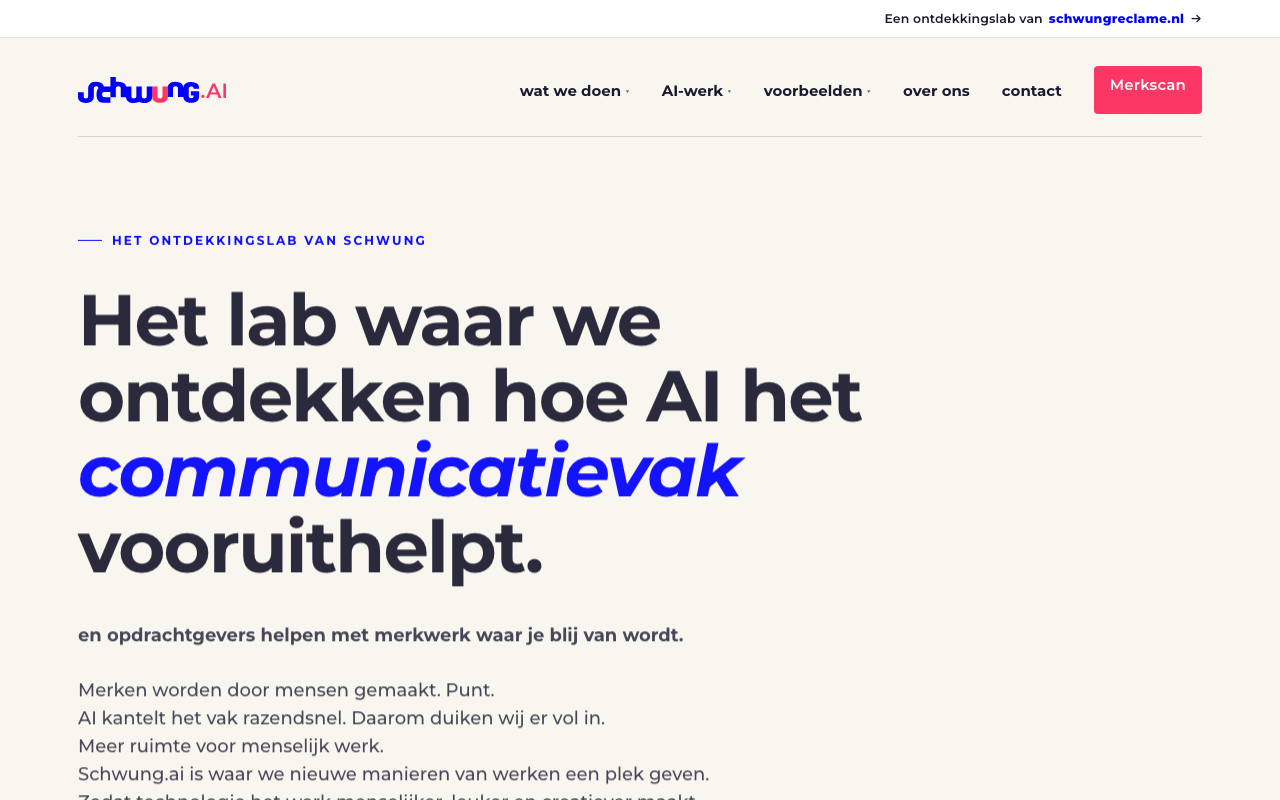
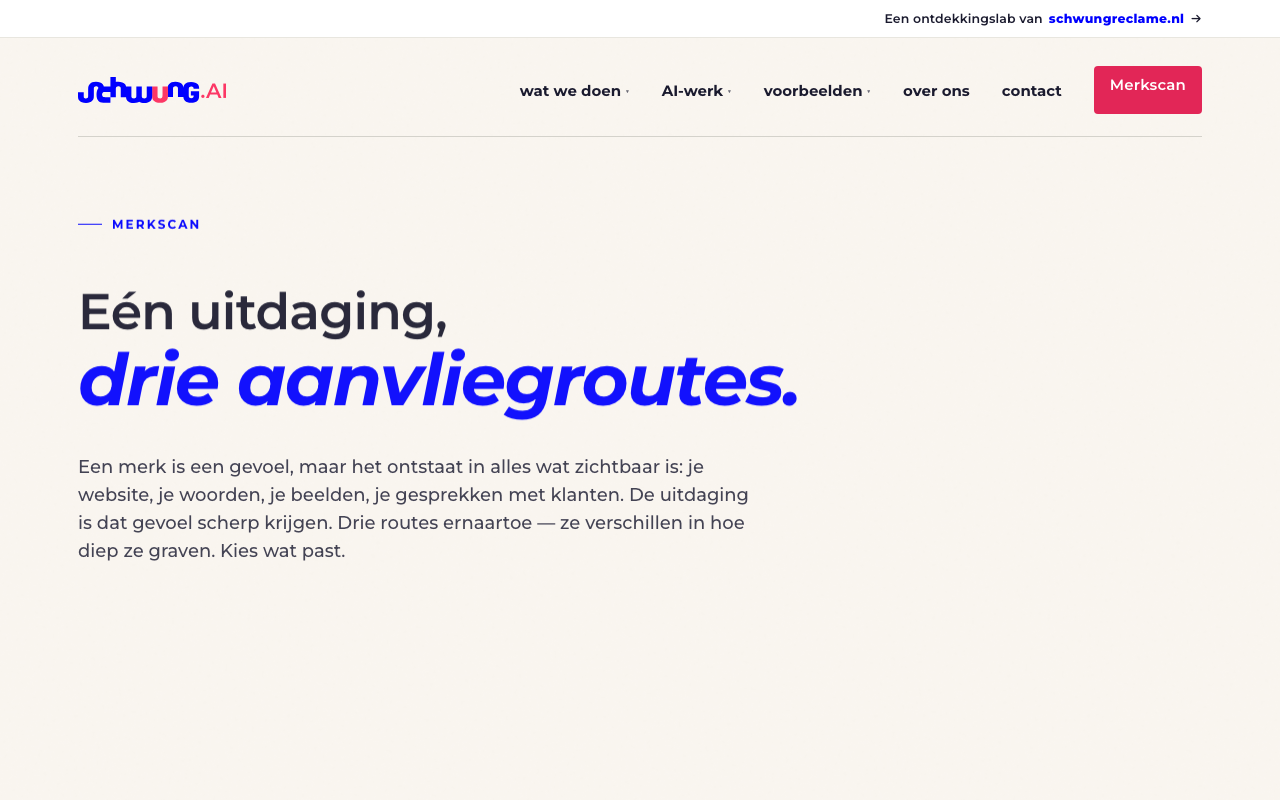
Brand scan v1
What it isThe AI brand mirror, as a classic questionnaire (21 questions).
What happened21 questions (s0 to s10), an adaptive matrix with word sliders, a Quinn score and 60 archetype images, with an AI reflection at the end. Solo and as a team, with a separate lighter scan for colleagues.
"The first scan was up surprisingly fast. Then the real work began."
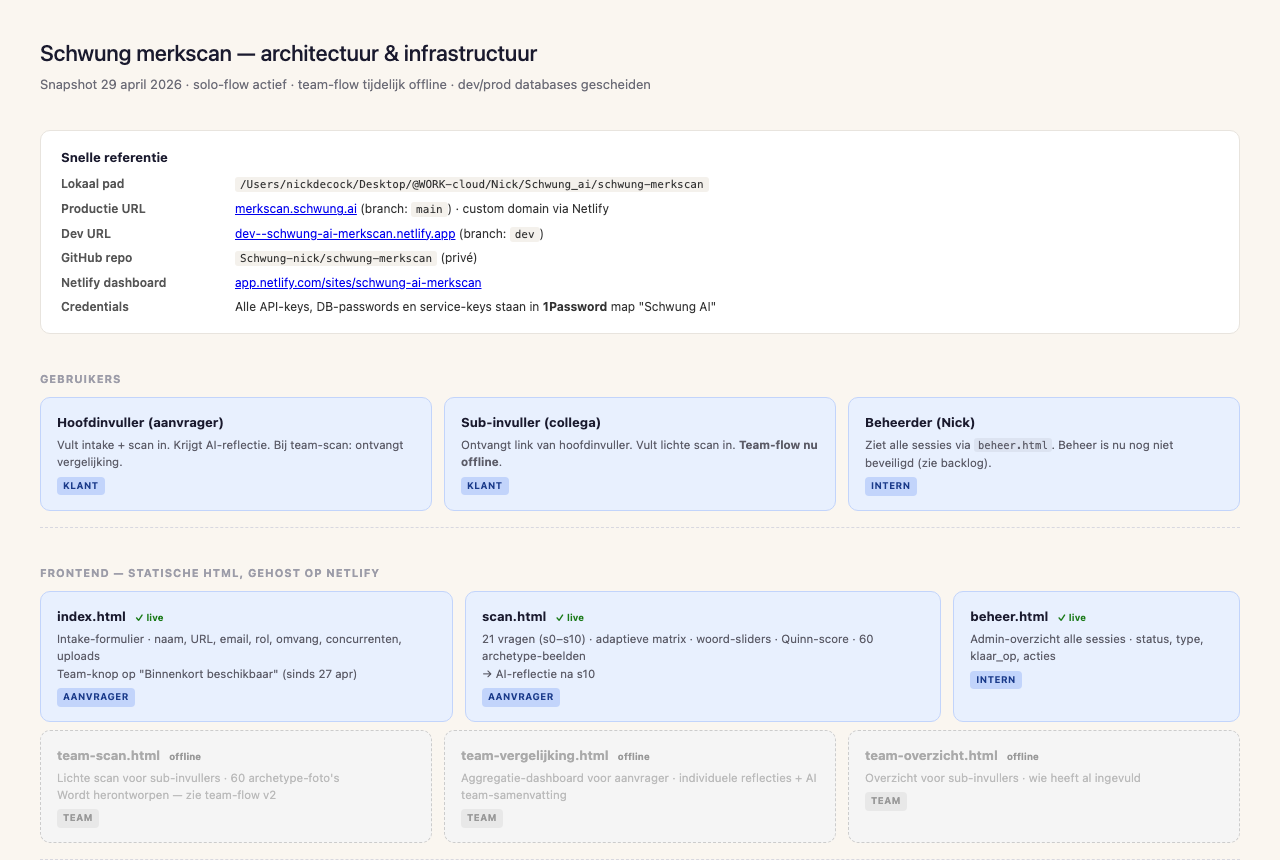
The admin environment
What it isThe admin dashboard behind the scan.
What happenedVersion-aware management (v1 and v2 per session), a feedback flow and separate test tools for the agents. The work nobody sees, but that keeps everything running.
"Nobody sees the admin environment. And without it nothing works."
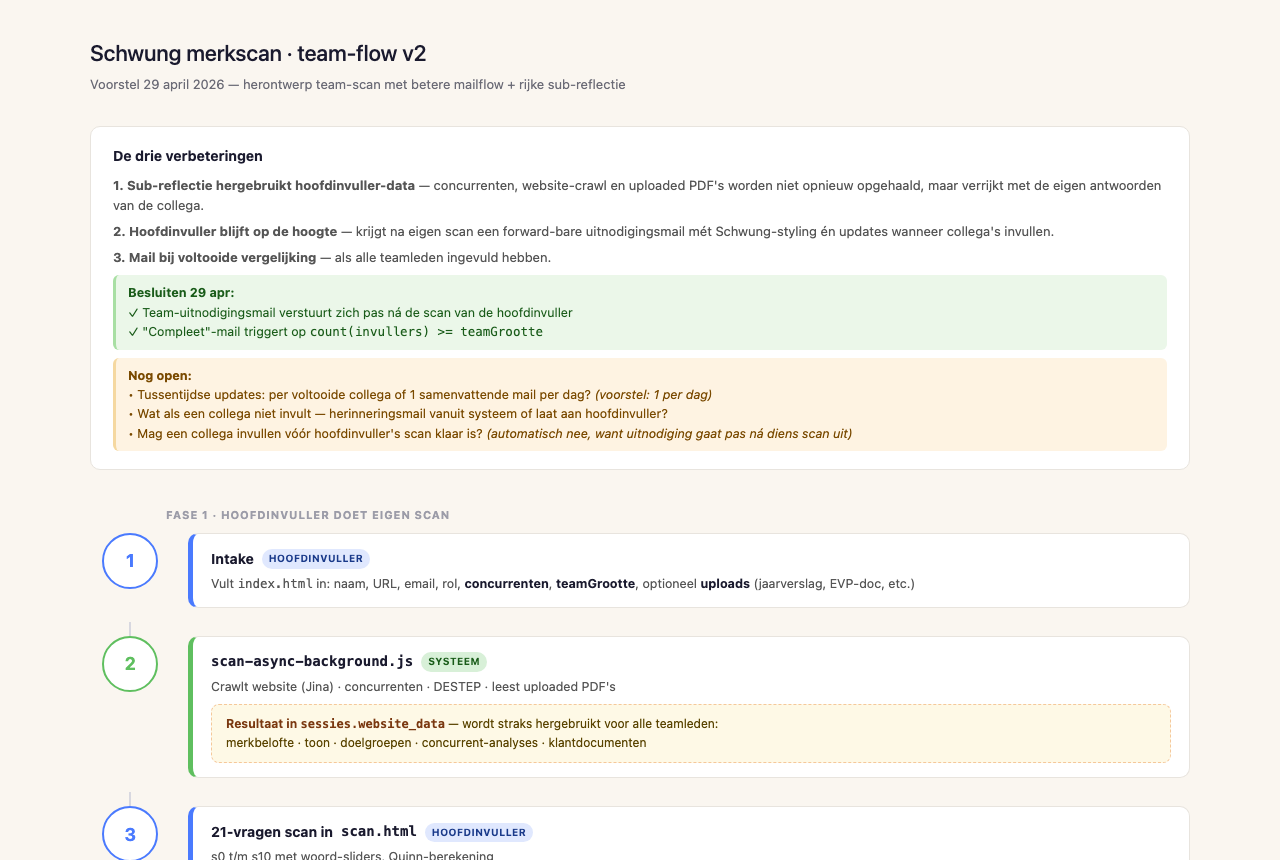
v2, and then conversational
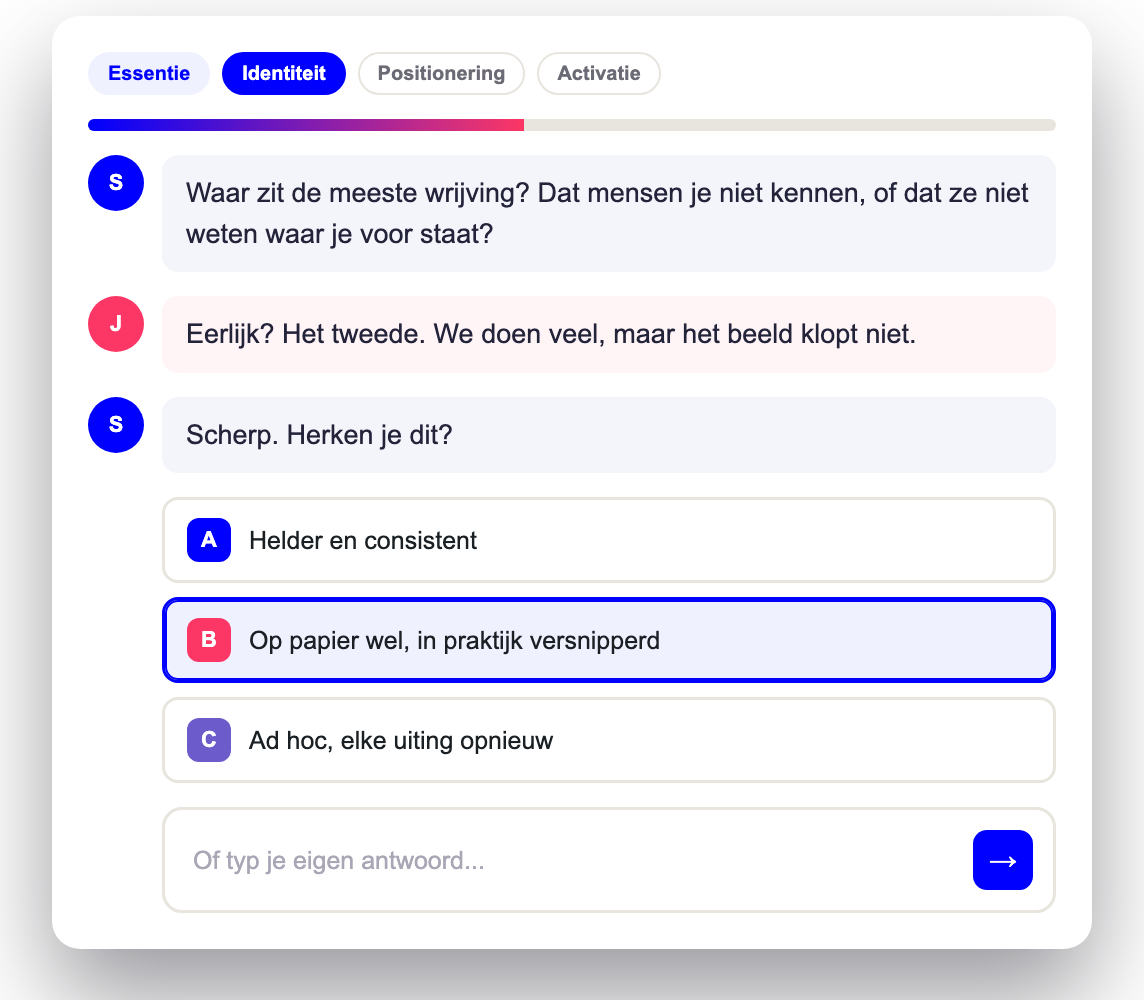
What it isThe scan that talks back.
What happenedFrom questionnaire to a conversation: five specialist agents, four pillars and the ABCs, a visual scan in the chat and a brand-image report with a Quinn quadrant and archetype. The hardest climb, and the biggest leap.
"The conversational scan cost us the most nights. And delivered the most knowledge."
The rest of the website
What it isService pages, cases, navigation, the whole site around it.
What happenedPage after page built up, all in one style and one tone. The heavy lifting nobody applauds, but that makes the difference.
"Sometimes you build something, and the week after you take it down again. That comes with the territory."
The Content engine
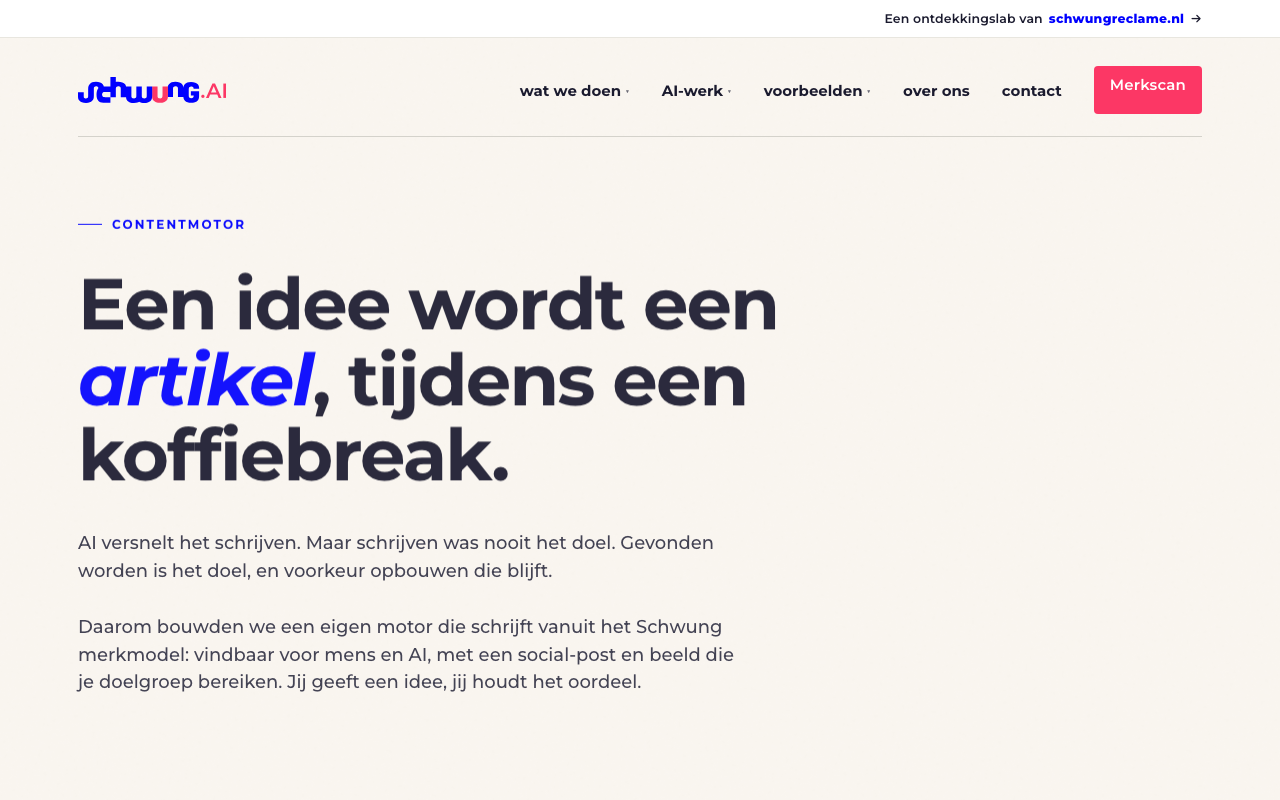
What it isThe engine that writes and publishes our blog.
What happenedIdea in, article out, live in about ninety seconds. The blog picked up pace: every week an insight and a LinkedIn post, in our own tone.
"The engine produced texts quickly. But it took scientific research to actually give them the right structure."
Vabor: the first client
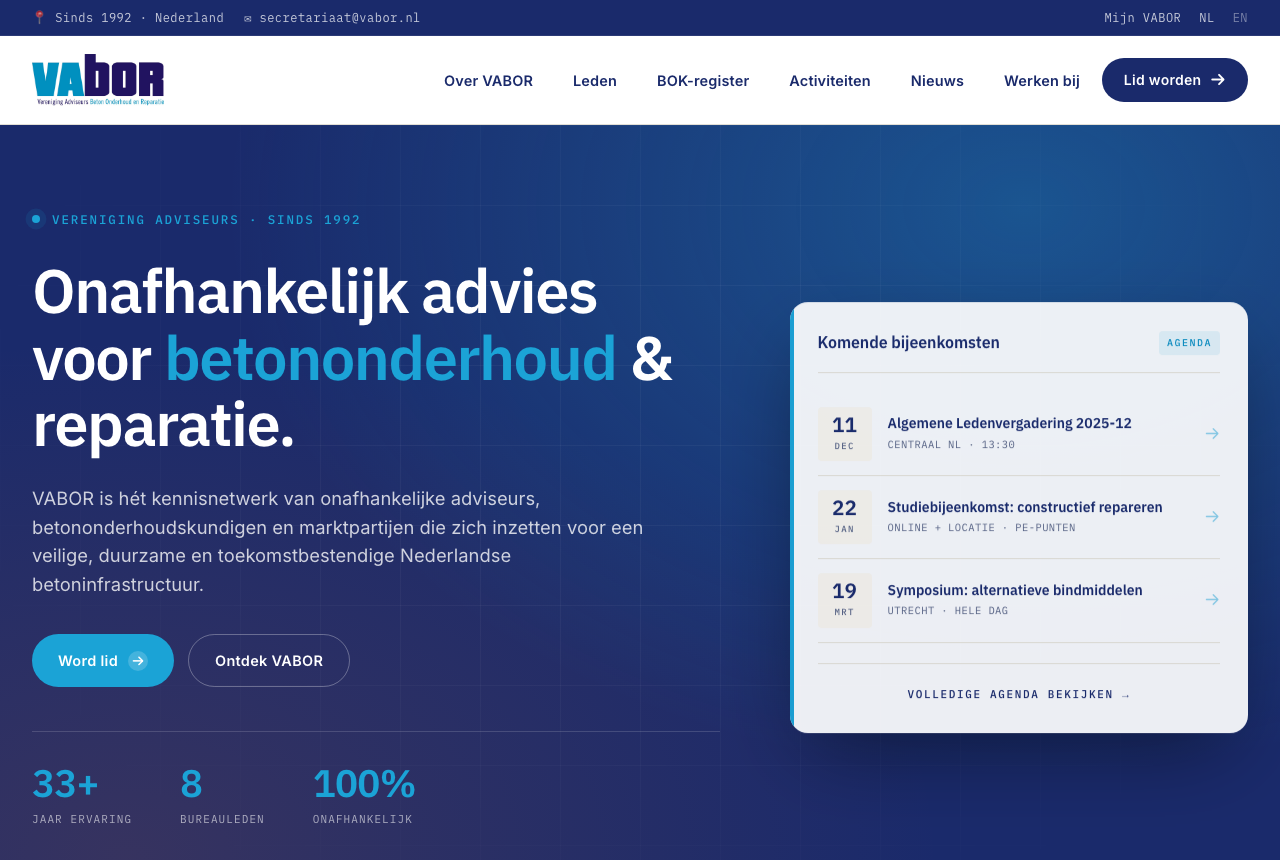
What it isThe first client project with the new approach.
What happenedA brand and website on a tight budget: the brand style by hand, AI carrying the design through, built in WordPress with its own CMS.
"The art isn't having AI build it, but delivering a design that fits the brand identity."
The workshop
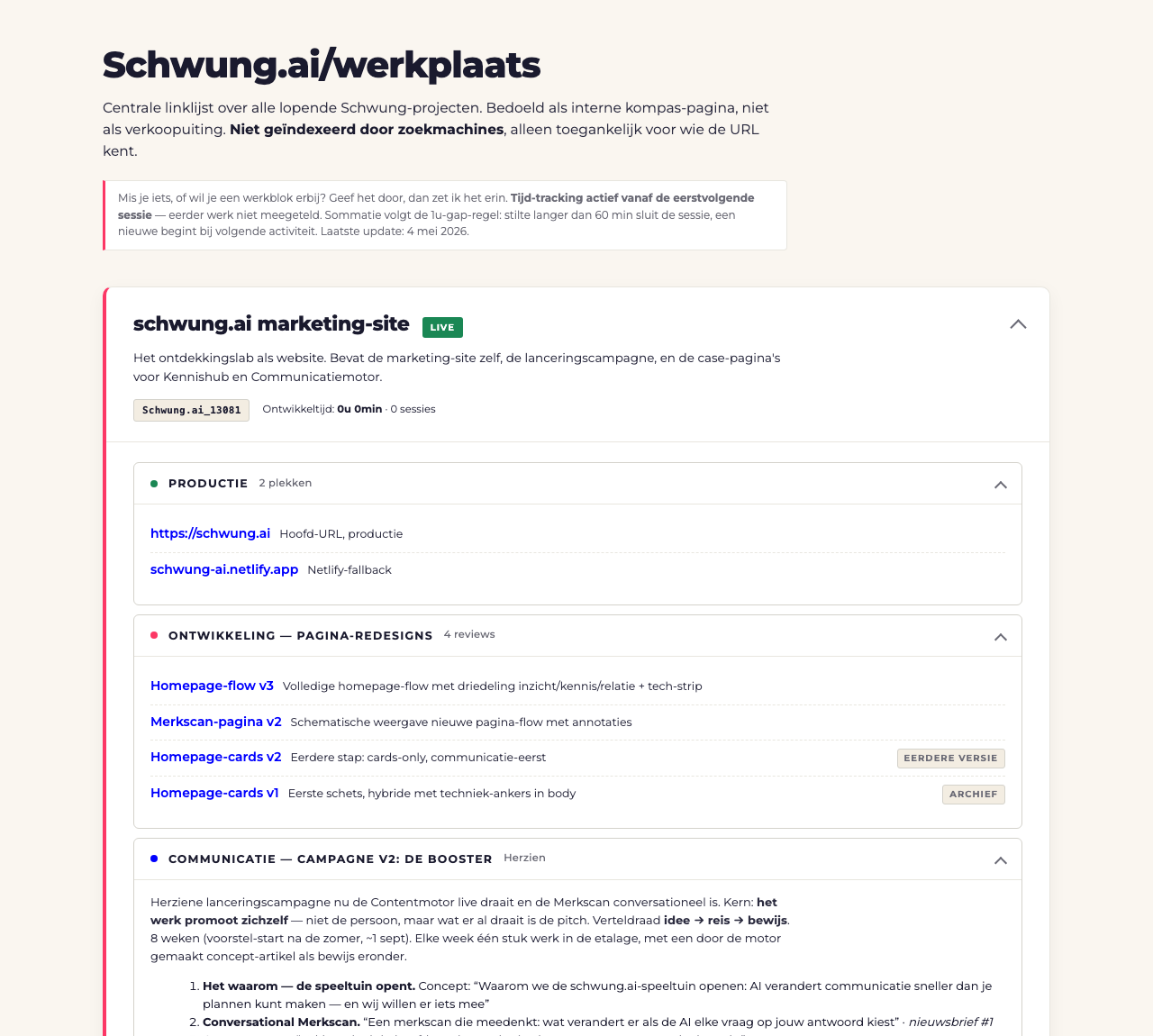
What it isThe internal compass: a central list of links across all ongoing projects. Not indexed, only for those who know the URL.
What happenedschwung.ai/werkplaats became the dashboard, with production, development, cases and communication per project, plus time tracking per session (the 1-hour-gap rule). Proof that the playground really did become a playground.
"One day you needed a map to take in your own playground."
The engines multiply
What it isA Case engine and a pop-up module, next to the Content engine.
What happenedThe same foundation as the Content engine, a different purpose. Materials in, a complete case for schwungreclame.nl out: with a chat to steer it, a check against the style guide and an English version made automatically. And a pop-up you place on a site with a single line of code.
"When the second engine stands in a week, you know the first was built well."
schwungreclame.nl rebuilt
What it isSchwung's main site, from Umbraco to the same foundation as schwung.ai.
What happenedOver six hundred commits in four months. A hub-and-spoke structure for findability, the cases from the Case engine, the pitches behind their own URL. Then the cutover: old site off, redirects on, and waiting for Google to notice.
"The lab rebuilt its own mothership."
The Brand mirror
What it isThe scan without questions. You only enter a website.
What happenedAfter the conversational scan, the reverse route: ask nothing, look at everything from the outside. Site, market and competitors, and a report in your inbox. Free, as a first step before the conversation.
"Sometimes the best first question is no question."
From client to sector
What it isThree engines that do the research: the competition engine, the Brand bank and the sector engine.
What happenedThe competition engine compares a set of websites on content, technology and structure, with a second model as an auditor that contradicts the first. The Brand bank distils four layers per client that feed all AI tooling. And the sector engine takes the client out of it: what does a whole sector do, from elderly care to education, childcare and municipalities?
"Everyone has an opinion. A count across a whole sector is another matter."
Pitches, and the engine behind them
What it isFive pitches in seven weeks, and a build chain that makes them from a single source.
What happenedEach pitch a short screen version and a full reading version from one source, with a yardstick for contrast and height. The quotes went the same way: content in a file, form and arithmetic from the format. One pitch we lost, and that lesson is now in the engine.
"It's not the part we're good at that decides. The client's question decides."
PackLogic
What it isSoftware for packaging compliance. The first product outside our own field.
What happenedSince August 2026 every piece of packaging must demonstrably comply with the European packaging regulation. PackLogic checks packaging against those rules and those of every country you sell in, reads the artwork and builds the file per package that proves it. In five steps, in use with a first client, with its own page on this site.
"The same way of working, a different subject. And it worked."
And this is only the beginning.
The playground is open. Curious what this same thing could do for your brand and communication?
Start a discovery conversation →